When Did the Stewart Kings After Janes I Become Catholic Again
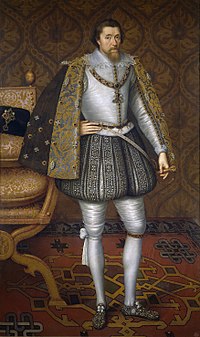
James 6 and I (James Stuart) (June 19, 1566 – March 27, 1625), Male monarch of Scots, Rex of England, and King of Ireland, faced many complicated religious challenges during his reigns in Scotland and England.
In Scotland, he inherited a reformed church, the Kirk, which was attempting to rid the country of bishops, dioceses, and parishes and establish a fully Presbyterian system, run by ministers and elders. Yet, James saw the bishops equally the natural allies of the monarchy and frequently came into conflict with the Kirk in his sustained try to reintroduce an episcopal polity to Scotland.
On his succession to the English throne, James was impressed by the church building organisation he found there, which however adhered to an episcopate and supported the monarch'due south position as the head of the church. On the other hand, there were many more Roman Catholics in England than in Scotland, and James inherited a set of penal laws which he was constantly exhorted to enforce against them. Earlier ascending the English throne, James had bodacious the Earl of Northumberland that he would not persecute "any that volition exist quiet and give but an outward obedience to the constabulary," merely he before long reinforced strict penalties confronting Catholics. Partly triggered past Catholics' disillusionment with the new king, the Gunpowder Plot of 1605 led to a new moving ridge of anti-Catholicism and even harsher legislation. In 1606, an oath of allegiance was introduced, though its enforcement afterwards slackened.[ane] His policy of seeking a Spanish Lucifer for his son, Charles, Prince of Wales, produced widespread opposition, especially in the Commons, where members feared a revival of Catholic power in the country and a threat to the Protestant monarchy and land.
Puritans and other Dissenters [edit]
On James's arrival in London, the Puritan clergy presented him with the Millenary Petition, allegedly signed by a thousand English clergy, requesting reforms in the church, particularly the abolition of confirmation, nuptials rings, and the term "priest", and that the wearing of cap and surplice, which they regarded every bit "outward badges of Popish errours", exist made optional.[two] James, withal, equated English Puritans with Scottish Presbyterians and, after banning religious petitions, told the Hampton Courtroom Briefing of 1604 that he preferred the condition quo,[3] with the monarch ruling the church through the bishops.[4] He therefore resolved to enforce conformity amongst the clergy, a conclusion which led in the short term to nearly ninety ejections or suspensions from livings and in the longer term to a sense of persecution among English Puritans.[5] A notable success of the Hampton Courtroom Conference was the commissioning of a new translation of the Bible, completed in 1611, which became known as the Male monarch James Bible, considered a masterpiece of Jacobean prose.[6]
James, who took an interest in the scholarly decisions of the translators, frequently participated in theological debate. In 1612, for example, he wrote a tract confronting the unorthodox Dutch theologian Conrad Vorstius, a follower of Jacobus Arminius.[7] A twelvemonth before, he had imprisoned a dissenter chosen Bartholomew Legate, with whom he had frequent audition during the protracted court proceedings. Co-ordinate to a court official, on hearing that Legate had not prayed to Christ in 7 years, the king in choler spurn'd at him with his foot; Away, base fellow (saith he), it shall never be said that one stayeth in my presence, that hath never prayed to our Saviour for seven years together.' In 1612, Legate was convicted of cursing heresy and was burned at the pale, along with Edward Wightman.[8] [9] Another dissenter, the General Baptist leader Thomas Helwys, appealed to James for freedom of conscience, only to be sent to prison house, where he died past 1616.[x]
Catholics [edit]
After the Gunpowder Plot in Nov 1605, the 3rd Catholic conspiracy against his person in three years, James sanctioned stricter measures to suppress them. In May 1606, Parliament passed an deed which could crave whatever citizen to take an Oath of Allegiance, entailing a denial of the pope'due south authorization over the male monarch.[xi] James believed that the Oath was simply concerned with civil obedience, a secular transaction between king and subject; but information technology provoked opposition among Catholics, as it did not explicitly restrict itself to political matters.[12] In early 1606, the Venetian administrator reported James as saying: "I do not know upon what they found this cursed doctrine that they are permitted to plot against the lives of princes".[13] James' policy aimed at punishing a few instead of creating bloodshed; Jesuits and seminary priests should simply exist asked to leave the state.[14] James proved lenient towards Catholic laymen who took the Oath of Allegiance,[fifteen] and tolerated crypto-Catholicism even at court. Henry Howard, for example, outwardly professed Protestantism merely remained a Catholic in individual and was received back into the Roman church in his final months.
Scottish church building [edit]
In Basilikon Doron, James chosen the Scottish Reformation "inordinate" and "not proceeding from the prince's order".[16] He therefore attempted to bring the Scottish kirk "then neir as can be" to the English language church and reestablish the episcopacy in Scotland, a policy which met with opposition from the Scottish Parliament and General Assembly.[17] In 1610, the boundaries of pre-Reformation dioceses were re-established, and in 1618, James'south bishops forced his Five Articles of Perth through a General Assembly; but they were widely resented and resisted.[18] James was to leave the church in Scotland divided at his death, a store of future problems for his son.[xix]
References [edit]
- ^ Krugler, p. 20–24.
- ^ Croft, p 156; Willson, p. 201.
- ^ When Puritans spoke against ceremonies because they had been used when England was Catholic, James said shoes had been worn when England was Catholic, so why didn't Puritans go barefoot? Willson, p 200. When an single Puritan speaker objected to the phrase "With my body I thee worship" from the union service, James replied: "Many a man speaks of Robin Hood who never shot his bow". Stewart, p 197.
- ^ If bishops were put out of power, "I know what would go of my supremacy," James objected. "No bishop, no King. When I mean to live nether a presbytery I will go to Scotland again." Willson, p. 198, p. 207.
- ^ "In things indifferent," James wrote in a new edition of Basilikon Doron, "they are seditious which obey not the magistrates". Willson, p 201, p 209; Croft, p 156; "In seeking conformity, James gave a name and a purpose to nonconformity." Stewart, p 205.
- ^ Willson, pp 213–215; Croft, p 157.
- ^ Willson, p 240.
- ^ "Page:Dictionary of National Biography volume 32.djvu/411 - Wikisource, the free online library".
- ^ Willson, pp 240–241. "Both men emerge as the victims of a circuitous series of events: the king'due south want to be seen as orthodox in the light of the Vorstius affair; the in-fighting for control of the ecclesiastical establishment on the peak of George Abbot to the archbishopric of Canterbury; and the campaign of the emerging anti-Calvinist grouping around Bishop Richard Neile against puritans". Atherton and Como, pp. 1215–1250.
- ^ In A Brusque Announcement on the Mystery of Iniquity, Helwys declared that "men's organized religion...is between God and themselves," and the king cannot judge "betwixt God and man...Let them be heretics, Turks, Jews, or whatsoever, information technology appertains not to the earthly ability to punish them." Watts, p 49; Solt pp 145–7
- ^ Stewart, p 225.
- ^ James'south primary concern was security. Then long as the pope was allowed to sanction and encourage civil activity against any monarch he chose to anathematize, that monarch would be vulnerable to attack from subjects who regarded the pope, not the monarch, as their supreme leader. The Oath, therefore, was designed to discover which of James's Catholic subjects were potentially disloyal. James justified the Oath at length in his Triplici nodo, triplex cuneus. Or An Apologie [explanation] for the Oath of Allegiance, printed in 1608. Stewart, pp 225–7.
- ^ Willson, p 227; Stewart, pp 225–6.
- ^ In an accost to judges in 1608, James instructed that those who refused to leave be dealt with flexibly, unless they resorted to violence. Francis Bacon recorded James'due south exact words as "No torrent of blowd: poena ad paucos" (penalties to the few). Croft, p 161.
- ^ Willson, p 228.
- ^ Croft, p 163, p 165.
- ^ In March 1605, Archbishop Spottiswood wrote to James warning him that sermons against bishops were being preached daily in Edinburgh. Croft, p 164.
- ^ The V Articles of Perth were: only bishops could carry out confirmations; the five pre-Reformation Holy Days were to be reinstated (Christmas, Good Fri, Easter, Ascent, and Whitsunday); anybody was to receive communion kneeling; private communion was to be permitted for the sick or infirm; private baptism likewise. Croft, p 166; Willson, p 320.
- ^ Historians take differed in their assessments of the kirk at James'south death: some consider that the Scots might have come up round to the Five Manufactures eventually; others that James left the kirk in crisis. Croft, p 167.
Sources [edit]
- Atherton, Ian; and David Como (2006). The Burning of Edward Wightman: Puritanism, Prelacy and the Politics of Heresy in Early Mod England. English Historical Review, Volume 120, December 2005, Number 489, 1215–1250. Oxford: Oxford University Printing.
- Croft, Pauline (2004). Rex James. Basingstoke and New York: Palgrave Macmillan. ISBN 0-333-61395-3.
- Krugler, John D. (2005). English and Catholic: the Lords Baltimore in the Seventeenth Century. Baltimore: Johns Hopkins University Press. ISBN 0-8018-7963-9.
- Solt, Leo Frank (1990). Church and Land in Early Modern England: 1509-1640. Oxford: Oxford Academy Press.
- Stewart, Alan (2003). The Cradle King: A Life of James VI & I. London: Chatto and Windus. ISBN 0-7011-6984-2.
- Watts, Michael R (1985). The Dissenters: From the Reformation to the French Revolution. Oxford: Oxford Academy Press. ISBN 0-19-822956-ix.
- Willson, David Harris ([1956] 1963 ed). King James Half dozen & I. London: Jonathan Cape Ltd. ISBN 0-224-60572-0.
everettcareter1994.blogspot.com
Source: https://en.wikipedia.org/wiki/James_VI_and_I_and_religious_issues
0 Response to "When Did the Stewart Kings After Janes I Become Catholic Again"
Post a Comment