Wife Gets to Point and Says She's Gonna Shake Baby
A t offset, Craig Stillwell and Carla Andrews only vaguely registered the change at the infirmary; how the expressions of warm, calm concern in the doctors and nurses who had been helping them look later on their sick baby had iced over. It was xv August 2016, in the early hours of the morning, and their three-calendar month-one-time daughter, Effie, was fighting for life.
Two hours earlier, Effie had woken up screaming. Her parents, both 23, had no permanent habitation and were staying at Craig's father's place in Aylesbury, Buckinghamshire. They had all been asleep on the floor in the lounge: Effie in the travel cot that detached from her pram, Craig withal in the uniform he wore as a grass cutter. Carla thought the problem was acid reflux. She passed the infant to Craig and went to fix a bottle of formula in the kitchen. As she worked, Effie screamed and screamed in the other room. Suddenly she fell silent. Carla heard Craig panic: "Effie! Effie!" She rushed in. Craig, terrified, was property the kid. Effie was white-faced, limbs floppy, eyes fixed, gasping weakly for air.
Paramedics arrived at 3.19am, past which time Effie appeared expressionless. They reached Stoke Mandeville hospital at 3.50am. She roused a little and was taken for a encephalon scan. Later on, in the resuscitation unit of measurement, a doctor told them what they had found. Effie had suffered a bleed on the brain, and it didn't look similar it had been the first. Carla and Craig both started crying.
"Simply how could this happen?" asked Craig.
"We're going to await into information technology," the medico replied.
At that moment, Craig realised everyone had started treating them with a common cold, professional distance. Autonomously from one nurse, who remained kindly, all the reassuring faces were now difficult.
Later that morning, Effie was moved to the high-dependency unit. As the hours passed, the immature parents noticed lots of nurses and doctors peering in through the window, staring at them, before hurrying along. At about 3pm, two officers from Thames Valley Police appeared. Craig and Carla were taken to a modest room that was empty but for ii sofas.
"We believe you've harmed your child," said a detective sergeant.
Craig was placed nether abort for grievous actual harm. He became agitated. Both parents were told they would be taken in for questioning.
"I'thou not going anywhere," Craig shouted furiously. "I'm staying with my kid."
He tried to run out of the room. In that location was a commotion. 2 more police force officers outburst in. And then Craig was on the floor, sobbing, his face pressed into the rug. He felt a steel band lock on to his left wrist. His arm was pulled back painfully.
"I'grand sorry," he cried. "I'thou distressing. If you lot take the cuffs off, I'll go voluntarily."
"It's too late for that," said the officer.
Back in the ward, Carla went to say goodbye to Effie. Tearfully, she went in for a cuddle. Only the one nurse who had shown kindness all day at present abruptly intervened.
"Yous tin can't bear on her," she said.
Officers searched their temporary home, removing letters and laptops, while, at the police station, the parents were interviewed separately, each for nigh three hours. They kept asking Carla: "Could yous meet Craig when it happened? He'due south got a atmosphere, hasn't he?"
The police force were satisfied that they knew what had taken place. Effie's brain scans told the story. They had shown the three tell-tale symptoms that are believed to be indicative of abusive head trauma, more than unremarkably known every bit shaken baby syndrome. Experts call these symptoms "the triad". Effie had brain swelling, bleeding in the optics, and blood in a protective layer that sits betwixt the brain and the skull chosen the dura – injuries that can cause blindness, serious disability, epilepsy and, often, death. Equally the report later filed by the local authority would conclude, they were "likely to be due to an episode of calumniating head trauma involving a shaking mechanism".
Just before midnight, the shattered parents were immune dwelling. Every bit they stepped out of the police station, Carla nervously and quietly asked Craig, "You haven't washed anything, take you lot?"
He shook his head. "How could you even think that?"
D espite the certainty with which police, hospital staff and their local authorization treated Effie's parents, the science that underpins shaken baby syndrome is anything but sure. In fact, questions almost whether the triad of symptoms found in Effie's scans are caused by abuse or other innocent events take seen medics, scientists and the police get to war. And information technology's a war that is being played out in courtroom after courtroom – with the fate of the accused parents hanging on how well 1 expert or some other happens to make their example.
On one side, there's the view of the police, prosecutors and the medical establishment: when this triad of symptoms is establish, it very strongly suggests shaking, even when other signs that a baby has been aggressively shaken, such as bruising, cervix injuries or fractures, are absent. The establishment insists information technology is solely motivated by a desire to protect babies from dangerous parents; it sometimes characterises opponents equally seeking fame, or lucrative skilful-witness pay cheques.
On the other side are the sceptics. They insist the prosecutorial forces aren't concerned with justice so much as courtroom victories. They bespeak to high-profile cases in which triad prosecutions have been overturned, and parents who have been wrongfully imprisoned and had children taken away. They say you can't await at an x-ray or browse and deduce that a infant has been shaken. According to leading sceptics such as Dr John Plunkett, of the Regina Hospital in Hastings, Minnesota, shaking doesn't fifty-fifty cause the triad. "Yous tin't cause these injuries past shaking," he says. "It'due south something else; the kid has banged its caput on the ground or there's some other underlying affliction."
Both sides avowal their own authoritative specialists, steeped in the scientific discipline, many of whom are informed by a lifetime'south clinical or laboratory experience. Simply the consequences could inappreciably be more than grave. It's impossible to observe accurate figures on charges or convictions, because shaking-related charges are brought in myriad ways, including manslaughter, child corruption, grievous bodily impairment, child neglect and so on. It is believed, though, that about 250 shaken infant prosecutions are heard in the UK every year. In the United states of america, the effigy is more like 1,500 – and there are idea to be at least v parents currently on death row, awaiting execution for shaking their babies to death.
While the sceptics have an armoury of horror stories nearly wronged parents, the other side has its ain tales of terrible injustice featuring abused babies. Accept the case of 7-calendar week-old Ellie Butler. On the evening of 15 February 2007, Ellie suddenly turned white, her limbs became floppy and she started gasping weakly for air. Her father, Ben, rushed her to London's St Helier hospital. Ellie had no other serious signs of injury, the family unit had no previous child protection issues. But Ellie showed the triad.
Ben Butler was arrested. In pre-trial proceedings, leading sceptics argued that Ellie's triad could feasibly be explained by complications triggered by a cyst in her throat. But the scan reportedly showing the cyst was never shown to the trial jury. Butler was convicted of causing grievous actual harm and cruelty and imprisoned.
Butler appealed. At his 2010 hearing, paediatric neuroradiologist Dr Neil Stoodley argued strongly that Ellie's injuries were caused past abusive shaking. But his testimony failed. One of the judges called Butler's confidence a "gross miscarriage of justice". An article in the Dominicus (since taken offline) detailed with outrage how Butler and his partner Jennie Greyness lost access to their two daughters for five years. Butler complained that his trial only "revolved around medical show". Gray insisted: "If anything, he was an overprotective dad."
In October 2013, Ellie Butler was killed. A court found that, prior to her death, Ben Butler had subjected her to weeks of escalating violence, leading to a fatal attack that left her with "catastrophic head injuries". He was sentenced to life in prison house. Grey received 42 months subsequently being found guilty of child cruelty and perverting the course of justice. I asked Stoodley, who had argued strongly that Ellie's 2007 injuries had been the result of shaking, about the moment he heard of Ellie's expiry. "I was shocked. Very shocked," he said. "At that place was a sense of failure. I felt the medical experts had failed her and the legal arrangement had failed her. I felt we'd all failed."
T he peculiar fact at the centre of the shaken baby wars is that it involves medical professionals establishing whether an illegal act has taken place. It is the diagnosis of a crime. Fifty-fifty when there is no corroborating evidence at all, doctors must decide whether they can spot signs of abuse with enough certainty to make life-changing assertions. Highly technical disputes, involving a subset of a subset of specialists, which would ordinarily play out in the footnoted and caveated pages of academic journals, are being argued in front of judges and juries.
The story of how this curious situation came to exist is, in many ways, the story of child corruption and our modern horror of it. It was a moral panic in the late 19th century that led to the creation of organisations such as the National Order for the Prevention of Cruelty to Children. That spasm of interest was triggered past the sensational 1874 trial of the foster carers of x-twelvemonth-one-time Mary Ellen Wilson, who had been beaten, burned, cutting, starved and repeatedly locked in a dark room in their domicile in Hell'due south Kitchen, New York. But public attending soon waned.
It took the widespread use of medical 10-rays for the issue of child abuse to surge once again. In 1946, paediatric radiologist John Caffey began to observe foreign, recurring patterns on X-rays of infants. They had haemorrhage in the dura and besides repeated os fracturing. Caffey was mystified. He wrote nigh this odd collection of symptoms in academic papers. What could be causing it? Scurvy? Rickets? Some strange new infant disease?
As x-ray technology became more common, other radiologists began noting the aforementioned patterns. Information technology wasn't until the early 1950s that some began cautiously wondering if parents might have some malevolent involvement. A few even went as far as to advise doctors should make subtle and tactful enquiries of the parents.
Then, in 1962, Dr C Henry Kempe published a landmark report in the prestigious Periodical of the American Medical Association. The Battered Kid Syndrome described 302 cases in which an infant had been deliberately harmed past a parent, with one hospital in Colorado treating four cases in a single day. Kempe added a chilling observation: in many cases, he said, "the guilty parent is the 1 who gives the impression of being more normal".
At the time, the notion that a parent – peculiarly an innocent-looking one – could deliberately damage their child was subversive and shocking. The editorial in the journal that carried Kempe'due south study conceded: "The implication that parents were instrumental in causing injury to their child is often hard for the physician to accept. But, regardless of how distasteful it may be, the history should be reviewed for possible attack and the necessary laboratory studies performed in lodge to confirm or reject suspicion." From today'south perspective, perhaps the most amazing thing is this astonishment, and the years it took doctors to take what at present seems tragically obvious – that outwardly ordinary parents tin indeed be violent or cruel. The shocked response to Kempe'southward 1962 study, writes Richard Beck, the writer of a history of child-abuse panics, "speaks volumes about the nuclear family'south status in postwar social club: the prestige, the respect, and specially the extraordinary degree of privacy that families regarded as their natural right".
Kempe'southward paper fell on the public'south naive notions of the safe and sacred nuclear family like napalm. National newspapers and magazines from Newsweek and Time to Good Housekeeping and Parents magazine ran panicked stories. Pop TV dramas such every bit Ben Casey and Dr Kildare began including child abuse storylines. Just three years after Kempe'south paper, 300 further studies of child abuse had been published. Shortly, every US country but one had introduced mandatory reporting legislation: now, when doctors found evidence of abuse, they were compelled past law to notify authorities. By 1974, 60,000 cases had been reported. 4 years afterward, that number had risen to more than a meg.
A specific cause for some of these injuries was suggested in 1972 by a British neurologist. Norman Guthkelch proposed that damage could be acquired by the brain existence thrown virtually inside the skull. In 1974, Caffey, the radiologist who had commencement detected strange symptoms on x-rays back in the 1940s, published a paper describing a "whiplash shaken infant syndrome", characterised by symptoms detectable on 10-rays, such every bit haemorrhage in the brain and eyes. "Usually," he wrote, "there is no history of any trauma of any kind." At present, when doctors found the telltale signs, there was an emerging body of literature that told them what caused it. The triad became the diagnostic tool for detecting violent corruption.
Meanwhile, across the US and Great britain, alarm well-nigh subconscious child abuse was rapidly accelerating. Everyone knew that child-abusing monsters looked like perfectly ordinary-looking mums and dads – and perfectly ordinary-looking mums and dads were everywhere. The 1980s saw the emergence of the "satanic panic", in which parents and carers were imprisoned for bizarrely deviant crimes. Fran and Dan Keller of Austin, Texas, were falsely accused of forcing children at their daycare to drink blood-laced Kool-Assistance and lookout the chainsaw dismemberment and graveyard burial of a random passerby. Despite the hallucinogenic insanity of the charges, the Kellers spent 21 years in prison house. (The couple were released in 2013 and fully exonerated in June this year.) The UK was not allowed to such hysteria. In 1987, 121 youngsters in Cleveland were judged to have been driveling, and removed from their homes, many on the basis of a test that judged levels of "anal dilation" that turned out to be associated with other factors such as astringent constipation.
By the belatedly 1990s, public scepticism was growing. The accusations had go too wild, journalists were investigating and a number of prosecutions failed. But just as things were calming down, the public'southward fascination was reignited by shaken baby syndrome. Attention turned from "satanic abuse" to the possibility that the babies of perfectly innocent-looking caregivers were being violently shaken.
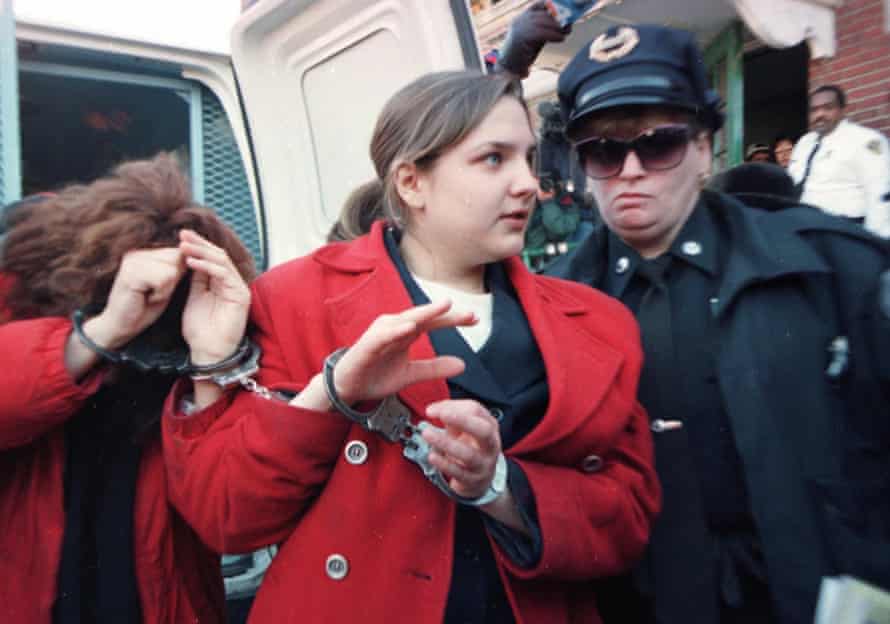
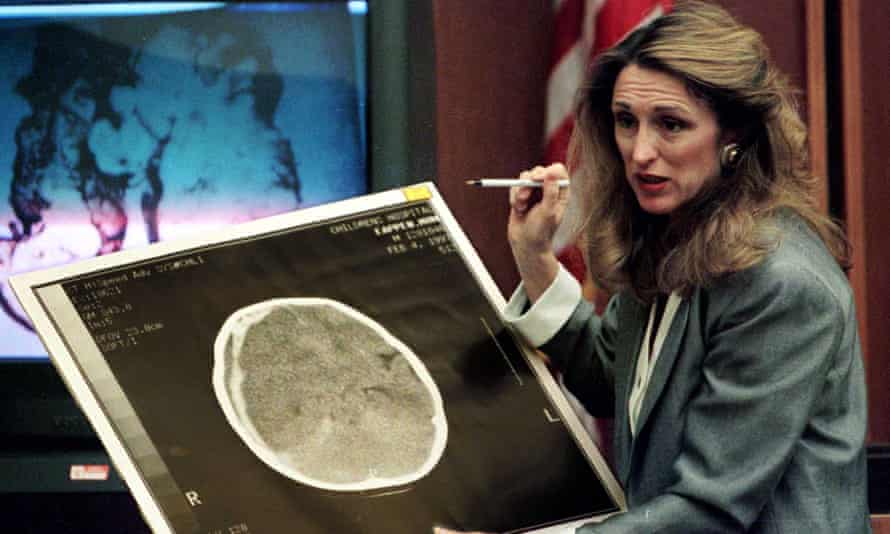
The spotlight savage on shaken infant syndrome following the sensational 1997 trial of a British nanny, 18-year-onetime Louise Woodward, who was defendant and convicted of shaking eight-month-old Matthew Eappen to decease at his home in Massachusetts. Matthew'south scans showed the classic triad. Symptom 1: haemorrhage in the dura. This was caused by the violent, during shaking, of the bridging veins that bleed blood from the skull. Symptom two: retinal bleeding. This was caused by tearing, during shaking, within the eye. Symptom three: brain swelling. This was caused past damage, during shaking, to nerve fibres in the brain.
Such injuries, it was said, could only accept been caused by shaking, which would lead to the child's instant collapse. Therefore, the person who was present when it happened was the guilty ane. That was Woodward. Under cross-exam, she admitted she had been "non as gentle as I might have been". It was suggested that she had caused re-bleeding of a previous injury. A jury establish her guilty of second-degree murder, and she was sentenced to 15 years to life.
Merely then something strange happened. After hearing the defence plea for the charge to exist changed to manslaughter, the estimate accepted that Woodward was non motivated by "malice in the legal sense supporting a conviction for second-degree murder" and reduced her sentence to just 279 days – time served. Woodward was gratuitous. In 2007, one leading prosecution witness, neuroradiologist Dr Patrick Barnes, recanted. The injuries, he told reporters, "could take been accidental". The triad, he had since come up to believe, was as well readily used as an indicator of corruption. "There is no doubt that errors take been made and injustices have resulted."
T he mean solar day afterwards Craig Stillwell was released on bail, a social worker came to call. With Effie however in infirmary, they had holed up at Carla's female parent's house. The visitor wanted them to sign an emergency protection order (EPO), granting the local authority shared responsibility for their daughter. The negotiation might have gone improve, but they say the social worker kept calling Effie "Ellie", even after existence repeatedly corrected. Eventually, Carla'southward mother had had enough. "You've got her name wrong 10 times! Now, fuck off." He reappeared, minutes after being thrown out, insisting their refusal to sign was irrelevant. "You need to get yourself a solicitor," he told them. "We're taking you to courtroom." The EPO was quickly granted.
Effie was notwithstanding unwell, but Craig and Carla struggled to go any data most her health. When she suffered a seizure, they weren't informed until eight hours later. They rushed to the infirmary and, Carla says, were forbidden to fifty-fifty look at her through a window. A doctor, citing the powers granted past the EPO, ordered them dwelling house.
On fifteen September, a weak but recovering Effie was discharged and placed into foster care. Her parents were allowed to come across her for 90 minutes three times a week at a contact centre. During those visits, they were watched from across the room by social workers, who made notes virtually everything they did in their daughter'due south presence. Meanwhile, preparations for the family unit court trial, which would decide whether they would be immune to have Effie back, had begun. Their solicitor told them about a superstar expert witness. She was bright, tough, outspoken and a profound sceptic, having told the BBC's Newsnight that the science of shaken baby syndrome was "rubbish". She had besides said: "There's no scientific bear witness to support information technology and in that location never has been." The but trouble was that she had been struck off by the General Medical Council, following a hearing in which she was found to have dishonestly represented the scientific discipline at several trials. Her name was Dr Waney Squier.
A paediatric neuropathologist based at Oxford'south John Radcliffe hospital, Squier has studied almost three,000 infant brains and contributed to more 120 peer-reviewed articles. During the 1990s, when Woodward was being tried, she was a triad laic. Back then, she believed what pretty much everyone did: that the triad is diagnostic of abuse. "I was cheerfully going along saying 'I agree it's SBS [shaken baby syndrome]'," she told me over coffee in the kitchen of her Oxford dwelling house. "I went along with the other boys." Every bit an in-demand expert witness, Squier'south testimony was used in the prosecution of several parents, including Lorraine Harris, who was jailed for manslaughter in 2000 afterwards her four-month-erstwhile infant showed the triad. Just past 2005, Squier was sufficiently convinced of her error to speak up during Harris's appeal. Harris was ultimately exonerated. Squier told me she felt "pretty bad" about her function in Harris's false conviction.
It was some footing-breaking work past neuropathologist Dr Jennian Geddes that first made Squier doubt herself. Geddes'due south findings, published in 2001, changed what most anybody idea they knew virtually shaken infant syndrome. Previously, the accepted view had been that violent shaking stretches and damages nerve fibres, known as axons, throughout a baby's brain. When this "diffuse axonal injury" (DAI), occurs, proteins that normally travel forth the axons are no longer able to do so. They begin to accrue, which is what causes the swelling. But Geddes had admission to a new technology, in the course of a stain that highlights this axonal swelling in slices of brain past colouring it gilt. "I used it on these babies who were alleged to accept been shaken [to death]," she says. "The gospel was that they'd suffered DAI, and I discovered that they didn't really take any axonal damage at all. At least, not caused by trauma."
Geddes'southward work was hugely compelling. Before long a powerful rebellion began to class. Curious experts, in other fields, began finding more than and more than reasons to doubtfulness the old theory. In the United states, the forensic pathologist Dr John Plunkett published work suggesting the triad could be caused by innocent "short falls" – accidental tumbles. Dr Marta Cohen at Sheffield Children'south Infirmary and Dr Irene Scheimberg at Barts in London published a newspaper arguing that dural haemorrhage and swelling could exist the ultimate result of a diverseness of complaints, from heart problems to sepsis to the re-haemorrhage of birth injuries.
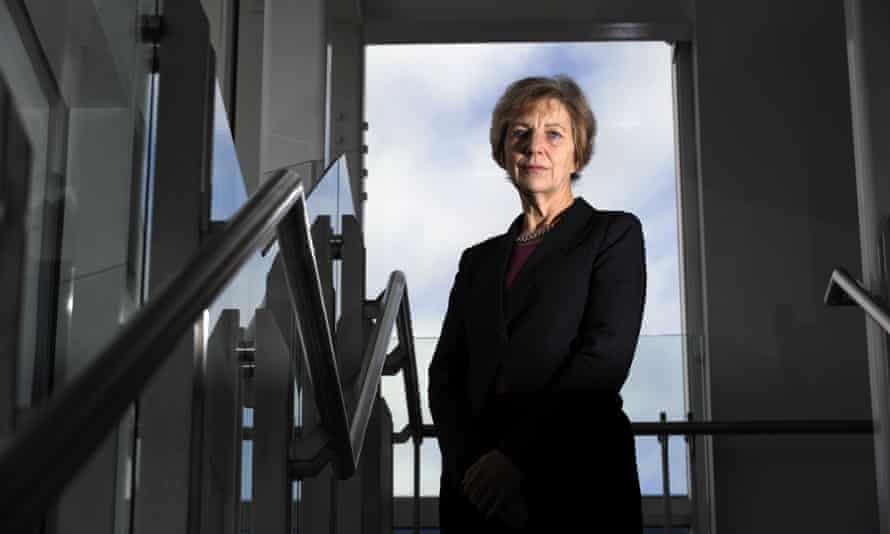
Doctors began questioning the idea that a baby could be killed by shaking and yet have no other signs of violent assault. "If yous grip a baby hard enough to shake it, you lot're going to trample information technology," says Squier. "Y'all're going to fracture ribs, you're going to break the neck. When babies in a frontwards-facing car seat are involved in a front-end collision, they get fractures and dislocations in their neck and back. They don't go shaken baby syndrome."
Others pointed to the troublesome fact that no witness had ever actually seen a baby being shaken then endure the triad. Norman Guthkelch, the British neurologist who'd showtime mooted the concept, became convinced that rampant injustices were taking place, and became a late-life campaigner against the "dogmatic thinking" of triad believers. It and then emerged that John Caffey, who published his influential 1974 newspaper shortly after Guthkelch, had based his theory about "whiplash shaken infant syndrome" primarily on a Newsweek scare story about an evil nanny who had harmed 15 children and described ambitious winding and shaking in an interview.
Over the years, starting in the 1990s, in that location was some softening of the thought that the triad always indicated corruption. And then, in 2003, the sceptics were handed another powerful weapon in the class of a brand new paper past Geddes. Colloquially known as "Geddes III", it described a scenario in which lack of oxygen from something as innocent as choking on something could crusade a pour of events resulting in the triad.
With the arguments against shaken babe syndrome gathering force, the rebellious scientists found themselves increasingly in-need as adept witnesses. Every bit they strode through courtrooms casting dubiousness on the science, prosecutions failed and bedevilled parents were released on entreatment.
The prosecutorial forces launched a counter-attack. Their kickoff victory came in 2005, during an appeal hearing against three shaken-baby convictions, including that of Lorraine Harris. Geddes, who admits she doesn't "find it like shooting fish in a barrel to think on my feet in courtroom", was cross-examined well-nigh her new newspaper, Geddes III, which was proving useful in overturning convictions. Under heavy questioning almost the science, she admitted: "I recall nosotros might not have the theory quite right." The QC retorted: "Dr Geddes, cases up and down the country are taking place where Geddes 3 is cited by the defense force fourth dimension and fourth dimension again as the reason why the established theory is wrong."
"That I am very distressing about," she said. "It's non fact, it's a hypothesis." She tried to point out that the conventional view of the triad was likewise just a hypothesis. Just it was too late. In their judgment, their Lordships wrote that the theory "can no longer be regarded every bit a credible or alternative cause of the triad". The Crown Prosecution Service issued a celebratory press release. Geddes saw the hearing as a calculated set on on her integrity. It was "horrendous," she recalls. "I was there for two days being cantankerous-examined. It was an attempt to close my theory downwards, to testify my research was rubbish and that I was dishonest."
By whom, I asked.
"I've no idea," she says. "The police. The CPS. I don't know."
W ith Geddes gone, the mysterious forces of "they" still had Squier, Cohen and Scheimberg to deal with. In September 2010, a plan to bargain with them was spelled out by a Met Police officer in a Powerpoint presentation. It was witnessed, at the 11th International Conference on Shaken Baby Syndrome in Atlanta, by the lawyer Heather Kirkwood. That year, fully one-half a decade after it happened, attendees were all the same jubilant the humiliation of Geddes. "They were making fun of her and doing mock-English accents and misquoting her testimony," recalls Kirkwood. "Information technology was quite a prove."
But it was a session led past child abuse homicide investigator DCI Colin Welsh that really startled Kirkwood. Information technology was, she says, "a clarification of the joint efforts of New Scotland Yard, prosecution counsel and prosecution medical experts to forestall Dr Squier and Dr Cohen from testifying for the defense force." Every bit presently as Kirkwood realised what she was seeing, she took out her pad and made frantic notes. Although not necessarily verbatim, they record Welsh explaining shaken baby prosecutions in the UK were in "dire straits", and that there was a "systematic failure" in securing convictions. Much of this was down to the "aforementioned handful of good witnesses showing up at trial to misfile the jury with the complexity of the scientific discipline". The programme was to go after them. Constabulary and prosecutors would question their qualifications, employment history and academic papers to "see if we plow up anything". Previous courtroom testimony would exist combed for potential problems. If issues were discovered, formal complaints would be fabricated.
Dorsum in the Great britain, Squier had already been targeted. On 23 June 2010, she was at her desk-bound in the hospital, deep into her morning'southward work, when she had a disturbing phone call. It was from a barrister with whom she had been working on a case. "Why didn't you lot fucking tell me you lot were upwards earlier the GMC?" he demanded. He was calling from court. "Because I'm non," she said. Squier was baffled. An investigation by the General Medical Council could hardly be more serious. "Don't exist so encarmine stupid."
"Well, this policeman walked into court this morning and told the gauge you were," said the barrister.
The GMC's paperwork arrived past registered postal service the side by side day. "It was atrocious," she says. "Absolutely horrendous." And it wasn't only Squier. Soon, Scheimberg and Cohen would acquire of deportment against them.
A body called the National Policing Improvement Agency had formally complained that Squier had dishonestly misrepresented the science of shaken baby syndrome in trials involving six infants between 2007 and 2010. Most of the allegations involved the cherry-picking of evidence, straying into areas outside her expertise and knowingly making statements that were unsupported by the scientific discipline. The bulk of the GMC hearings took place over six months from October 2015. "The hearing was awful," she says. "The cross-examination was unrelenting. Thrash, thrash, thrash." Expert witnesses she had opposed during trials testified against her. "I really thought the prosecution experts were so awful, then big-headed." The verdict, when information technology came, was crushing: 130 allegations against her were institute proved. Squier, said the judgment, had acted in manner that was "misleading, irresponsible, dishonest and likely to bring the reputation of the medical profession into disrepute". She was struck off. "It was pretty devastating," she says.
Squier appealed against the ruling of the tribunal. Although the appeal judge agreed that she had failed to piece of work "within the limits of her competence, to be objective and unbiased and pay due regard to the views of other experts," he crucially decided that she had not been deliberately quack. Her removal from the medical annals was reversed. She was, withal, forbidden from working equally an expert witness for three years, by which time she would exist at retirement age. Equally for the other two experts, Scheimberg was cleared later an investigation by the Man Tissue Dominance. Cohen's GMC complaint was dropped.
Ultimately, the plan was a spectacular success. It has been extremely effective in silencing the sceptics and preventing them profitable the defence force. "I receive weekly emails about doing cases of shaken baby," says Cohen. "But I'k not doing them." It'southward said to be increasingly tough finding anyone to speak up for people similar Craig Stillwell. One lawyer, Kate Judson, told reporters: "Without Squier, Cohen and Scheimberg, I don't have anybody to send them to."
Squier's opponents are unrepentant. "I was disappointed in the way she was acting in court," says Dr Colin Smith, a neuropathologist of 20 years' experience and lead witness at her hearing. "I didn't recollect it was adept for neuropathology." He insists that almost shaken infant cases are abusive and "relatively straightforward". So straightforward, in fact, that he doubts the motives of the sceptics. "Whether they truly believe what they are saying, I honestly don't know."
And yet the latest scientific bear witness seems to back up the sceptics. In 2016, Swedish academics published the most in-depth review of the literature on the triad yet, assessing 1,065 papers. What they found was "very low-quality scientific show" for the hypothesis that the triad is caused by shaking. Author Niels Lynöe told the New Scientist: "You lot can't use these studies to say that whenever you see these changes in the baby encephalon, the infant has been shaken. It's non possible co-ordinate to current knowledge."
Simply, Smith argues, you're never going to see such proof in a scientific study because the only style to scientifically show shaking causes the triad is to actually milk shake a babe. And, of course, that's not allowed. This, he argues, is why yous must as well await at the evidence from clinical practice. Take the argument that "short falls" can cause the triad. That's a nice theory only, in real life, "you lot only get the triad from such a fall when no 1 else is watching". When there are witnesses to a fall, yous typically find a very different pattern of bleeding too as fractures. "And that is not the triad," he says. The same goes for sepsis, eye complaints and the theory that oxygen starvation caused by choking tin can lead to the triad. "There isn't a single witnessed choking case that looks anything like this," he says.
Smith used research by Geddes to explicate 1 idea of how shaking did atomic number 82 to the triad. The conventional view used to be that it acquired widespread impairment to the axons in the brain. Geddes revealed this widespread damage was absent. Just she did notice that shaking could cause highly localised axonal impairment. "It happens where the brain meets the spinal string in the neck," says Smith. "If yous imagine the caput flopping about uncontrolled, this is where Geddes described the damage, exactly at this betoken where the head twists almost. This is where the centres that control heart function and respiration are."
Some other formidable force at Squire's GMC hearing was Stoodley. I arranged to encounter him in a buffet opposite St Pancras station in London. He had arrived from giving evidence at a shaking trial in Essex. Of the nearly 900 cases of triad babies he examined, he concluded that nigh 90% were caused past abusive shaking. Of that 90%, "about ten% are wilful and persistent abuse, and that leaves lxxx% when, in my view, the injury occurs equally a result of a momentary loss of control".
What this implies is that the majority of such cases involve no other injuries. No bruising, no neck injuries, no fractures or breaks. How can he be sure they take been shaken? "About all these injuries occur when the child is with a unmarried carer," he says. "It's non witnessed past anyone else. The holy grail of lawyers is to find a naturally occurring medical condition we've been missing all this fourth dimension that causes it. Let'south assume in that location is i. Virtually diseases tend to occur at different times of day. This i would have to exist somehow sentient and know the child it's about to cause trouble with is in the care of a unmarried carer." But this statement is wholly circumstantial, I protest. "Well it has to be," he says. "We can't practise the relevant experiments."
Stoodley has another powerful argument. In his day-to-solar day work at a major children'south trauma centre, he sees the triad occurring in concert with other obvious signs of abuse: "multiple fractures, bruises, burns, scalds". Just what nearly the earlier Geddes work that implies even light shaking could crusade it? Doesn't this show the triad could stem from innocent falling, or shaking and then mild y'all couldn't reasonably call it calumniating? "Humans just wouldn't have survived if we were that fragile," he says. But babies trample easily. "Correct." How come up we don't see bruising in then many cases of apparent shaking? "I don't know," he says. "Simply if you have a momentary loss of control, why would that cause bruising?"
T he triad believers contend that defense lawyers have been cynically seeking new and alternative causes of the three tell-tale injuries. "They move about," says Colin Smith. "At that place's been rickets, vitamin D deficiency and at present there'southward Ehlers-Danlos syndrome." EDS is a rare genetic disorder of the connective tissues, the vascular form of which can trigger rampant bleeding. But Smith is dismissive of it being a crusade of the triad. "Show me one single case," he says. "They just don't be." Instead, "many of these cases accept a very typical scenario. It's a young mother or father, very poor social back up around them, often limited education, and infant just won't stop crying and they snap for ane 2d."
When Craig Stillwell hired a solicitor who specialised in cases similar his, she asked him: "Take yous heard of Ehlers-Danlos Syndrome?" Stillwell and his partner, Carla Andrews, had plant Rachel Carter, of the firm Wollen Michelmore, after a Google search for "shaken baby". "A lot of her cases came upwardly," says Carla. She saw repeated references to EDS. "I don't know what information technology was, then I gave them a ring." Indeed, Carter, founder of parentsaccused.co.uk, is arguably one of the lawyers best known for using the EDS defence. In ten years of do, she says, she's had "10 to 12" EDS clients, "and they've all been inside the terminal couple of years".
Carla paid £250 for blood tests. By Valentine's Day 2017, all the results had come in. Both Carla and Effie had EDS. It fabricated sense to Carla. "It answered and then many questions I had about myself," she says. Carla bruises easily and spectacularly. Months earlier, she had posted a photo to Facebook jokingly complaining near a nurse who had "missed" while trying to insert a cannula. Almost her unabridged forearm was brownish and bluish. When Carla phoned her own solicitor to tell him virtually the genetic exam, he was delighted. "We're going to win," he appear. It was the first encouraging news they had had in a long time. Living without Effie was "absolutely horrible", says Carla. "I always woke up at three in the morning because that's when she used to wake up."
"And so I'd wake up hearing Carla crying, which was center-breaking," adds Craig.
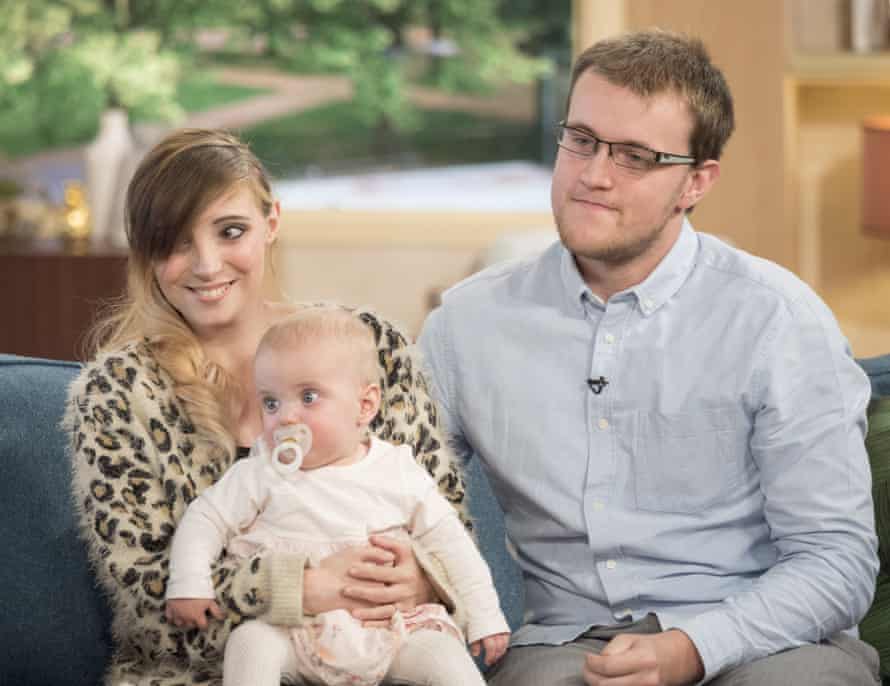
In April 2017, the family court took evidence from half dozen expert witnesses, including haematologist Dr Russell Keenan, who testified that Effie'south condition could lead to spontaneous haemorrhage "with no trauma whatever". The guess ruled that Effie's collapse was "near probable the result of a naturally evolving disease". She praised Craig and Carla's "maturity and restraint" and acknowledged the "unimaginable horror" they had lived through. Effie is now dorsum with her parents and thriving.
Only i expert witness was unmoved by Carla's diagnosis: Stoodley. "He was horrible," says Carla. "He was ever saying all this negative stuff and making it seem like it was fact."
"He was all for saying it was shaken infant [syndrome]," Craig says.
Stoodley remains convinced Craig and Carla's baby was shaken. "That was the conclusion I came to and I've not been made aware of anything since my judgment that would make me wish to alter information technology," he said. "I'thou not aware of any clinical evidence to support EDS as being causative of this pattern of injury."
Today, 16 years subsequently Geddes published the newspaper that convinced Waney Squier she was wrong, and ii decades after the awful drama of the Louise Woodward trial, the war continues. Prosecutors accept silenced their nigh powerful court enemies, and influential scientists proceed to cast doubt on the science of the triad, while experts such as Colin Smith use compelling clinical evidence to convince judges and juries that the triad is, indeed, potent bear witness of abuse.
And for Stoodley, likewise, the facts are equally certain equally they take ever been. But, surprisingly for a human being who has testified against hundreds of parents, he confesses to profound doubts virtually the justice of putting them in prison. "There should exist something else on the statute book, like aggravated manslaughter, to permit more than nuance," he said. And that charge shouldn't necessarily atomic number 82 to a custodial sentence. "I'm not sure locking people up is the answer. I think the worst sentence society could impose on a parent who had just lost information technology for a moment is watching your child grow up handicapped because of something you knew you had done." When he was a babe, he says, he cried all the fourth dimension. "My mother always said she was amazed I survived infancy." He smiles ruefully. "About of us who are parents have been pretty close to information technology, I suspect."
everettcareter1994.blogspot.com
Source: https://www.theguardian.com/news/2017/dec/08/shaken-baby-syndrome-war-over-convictions
0 Response to "Wife Gets to Point and Says She's Gonna Shake Baby"
Post a Comment